Context:
Edit : 9th november 2014:
Read up to date using last version of our plugin here.
You use JMeter and want to test an application that massively uses JSON data as exchange format.
JSON has become a de-facto standard nowadays and is used often:
- To return data through Ajax Calls within dynamic websites
- To return data through HTTP calls for Mobile Applications
- As a REST webservice exchange format
- As a storage format for NO-SQL databases like MongoDB
- …
Of course you can still extract content with core JMeter using Regular Expression Extractor but this becomes quite tedious, inefficient if not impossible when you have a lot of JSON elements with same attribute names.
You can also use alternate approaches which you will find googling a little:
- BSF or JSR223 Post Processor using Javascript which will transform response to Javascript variable and process it => DRAWBACK : Performance of JMeter are highly impacted
- BeanShell and a JSON library => DRAWBACK : Lot of Beanshell code to write and impact on JMeter performances
This is where UBIK JSON Plugin comes to the rescue.
Description:
Our plugin uses the JSON Path syntax as described in this article:
- http://goessner.net/articles/JsonPath/
This syntax enables very easy extraction for JSON format as we will see in following example
Example:
Suppose we have a GET HTTP request that returns the following content:
{ "store":

{"book": [{ "category": "reference","author": "Nigel Rees","title": "Sayings of the Century","price": 8.95},

{ "category": "fiction","author": "Evelyn Waugh","title": "Sword of Honour","price": 12.99},

{ "category": "fiction","author": "Herman Melville","title": "Moby Dick","isbn": "0-553-21311-3","price": 8.99},

{ "category": "fiction","author": "J. R. R. Tolkien","title": "The Lord of the Rings","isbn": "0-395-19395-8","price": 22.99}],

"bicycle": {"color": "red","price": 19.95}} }
And we want to extract:
- author of the first book
- title of last book
- all authors and iterate
How-To:
To do that we will first create the HTTP Sample that returns the JSON response and use the UBIK LOAD PACK JSON TESTER view in View Results Tree:
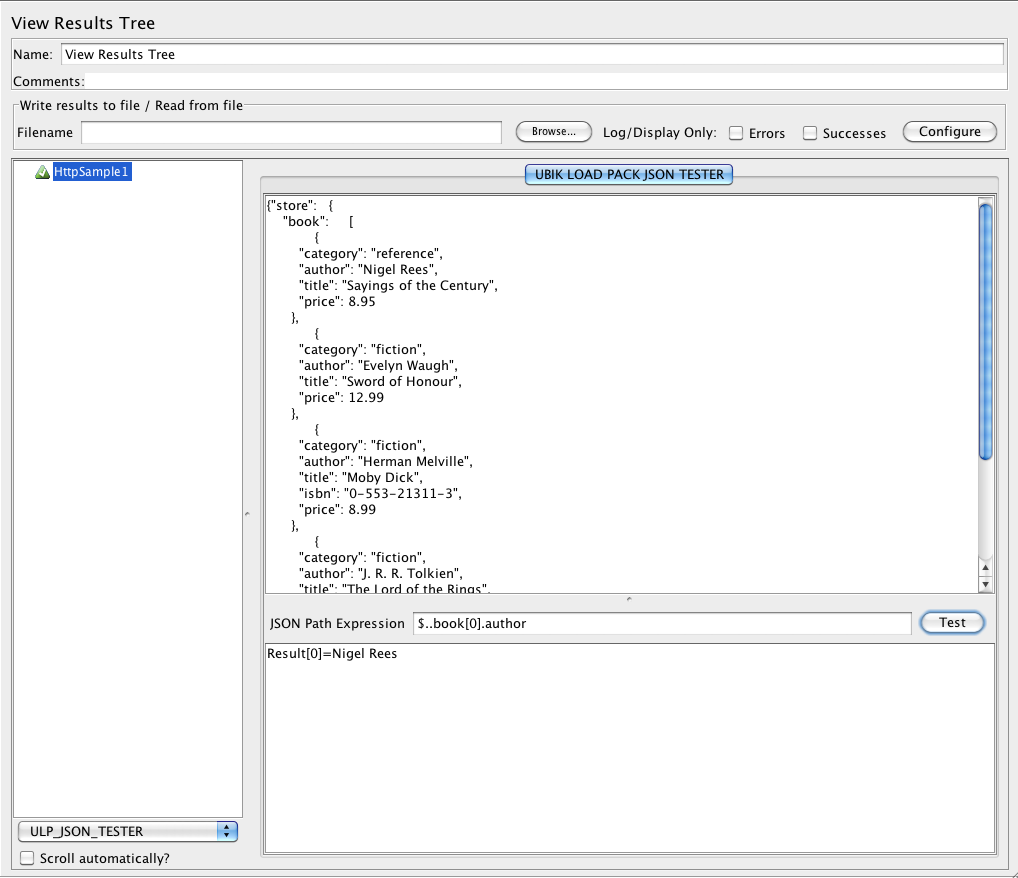
As you can see this view:
- Formats the JSON response in a more readable format
- Adds a JSON Path Expression tester which helps you test and debug your JSON path expressions
Once we have found the correct syntax we can add the ULP_JSON PostProcessor to our sampler and extract our required data:
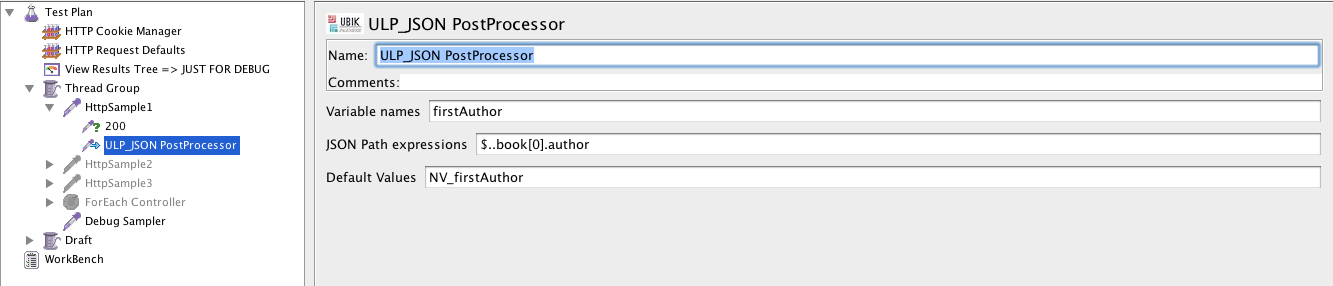
This will:
- Extract data from JSON response
- Store in firstAuthor variable the extraction result if found
- If not found, firstAuthor will contain NV_firstAuthor
- We can the use ${firstAuthor} in following elements to inject the data
Let’s see what happens by running the test:
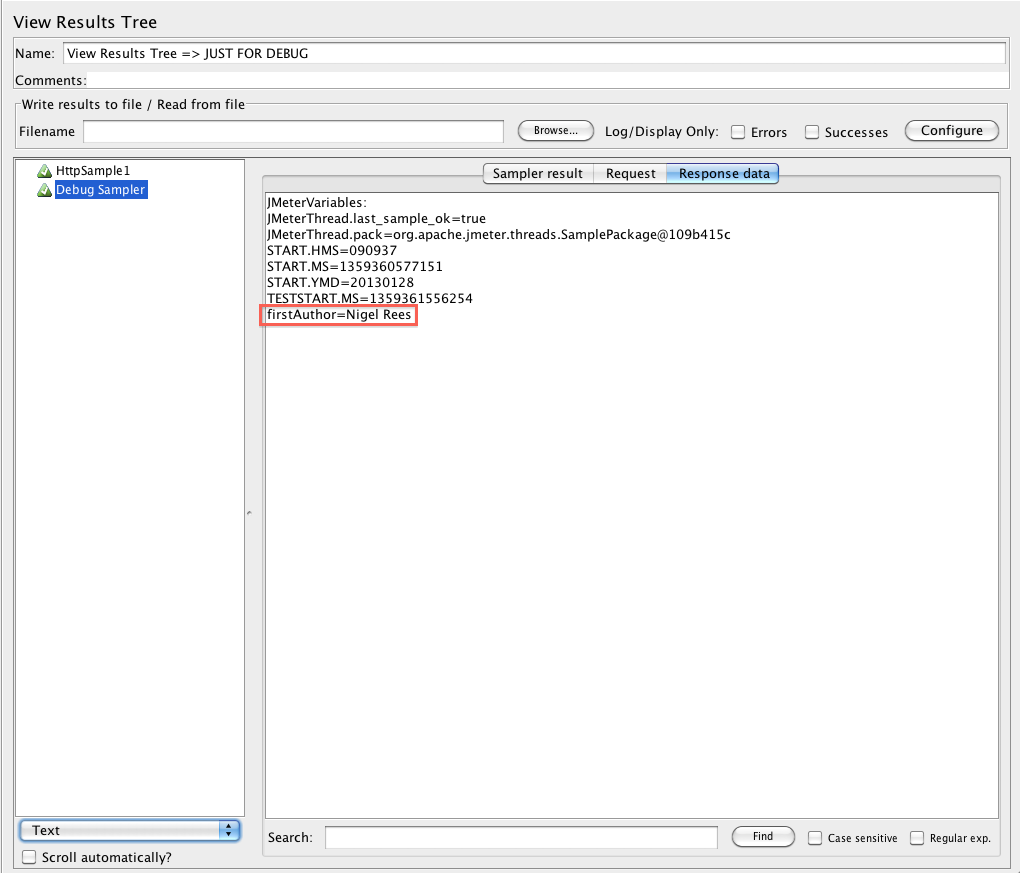
As you can see, firstAuthor variable contains the correct data.
Let’s now also extract title of book.
To improve performance and reduce code, Post-Processor allows extracting many variables in one shot, ULP_JSON PostProcessor changes to:
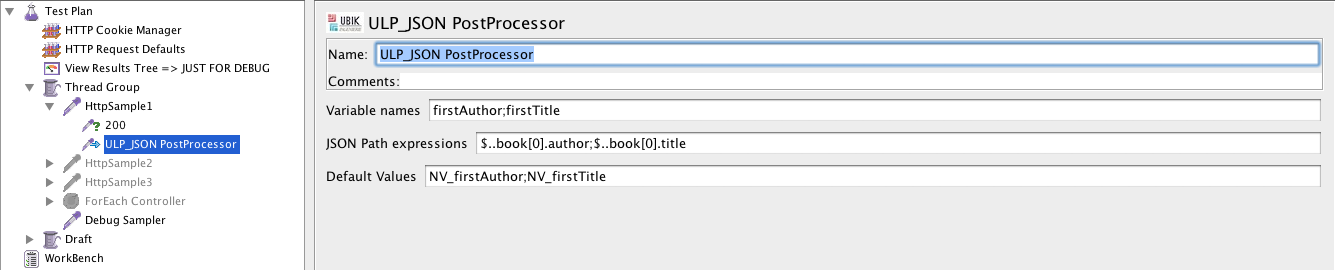
Let’s see what happens by running the test:
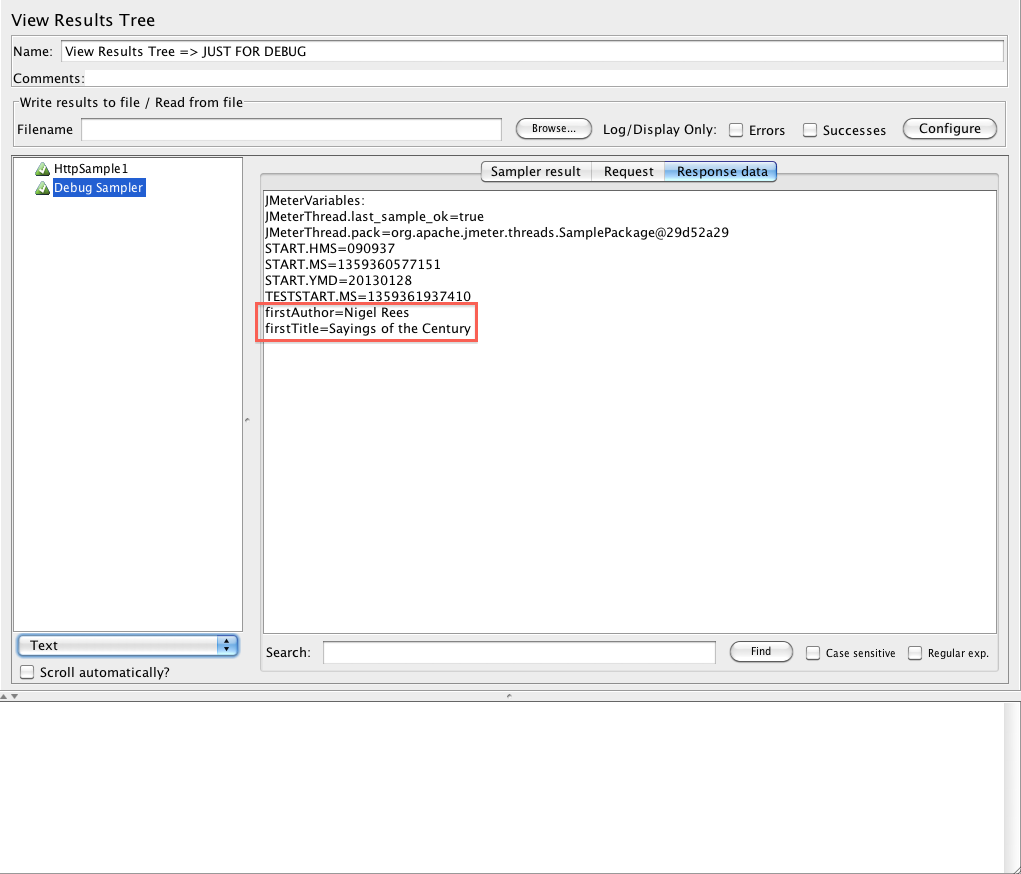
As you can see, we now have 2 variables:
- firstAuthor
- firstTitle
Extracting last author would be as simple as setting JSON Path Expression to:
- $..book[-1:].author
Just imagine doing this with regular expressions 🙂
And finally we can extract all authors through:
- $..book[*].author
And use a ForEach Controller to iterate over these:
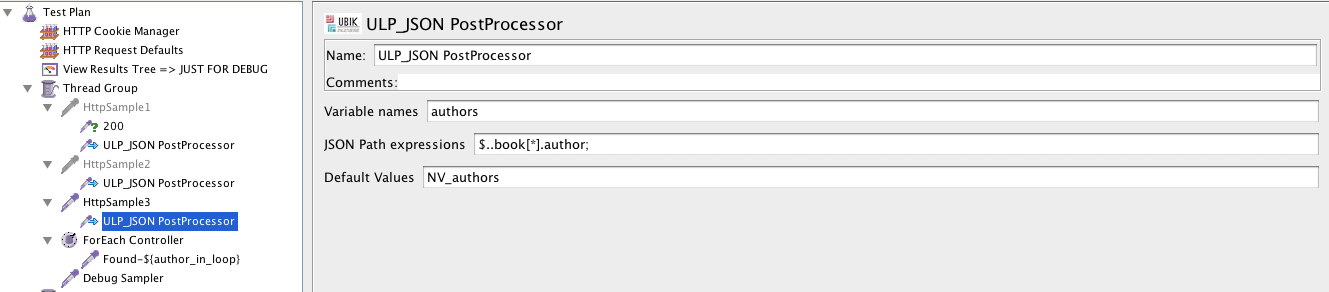
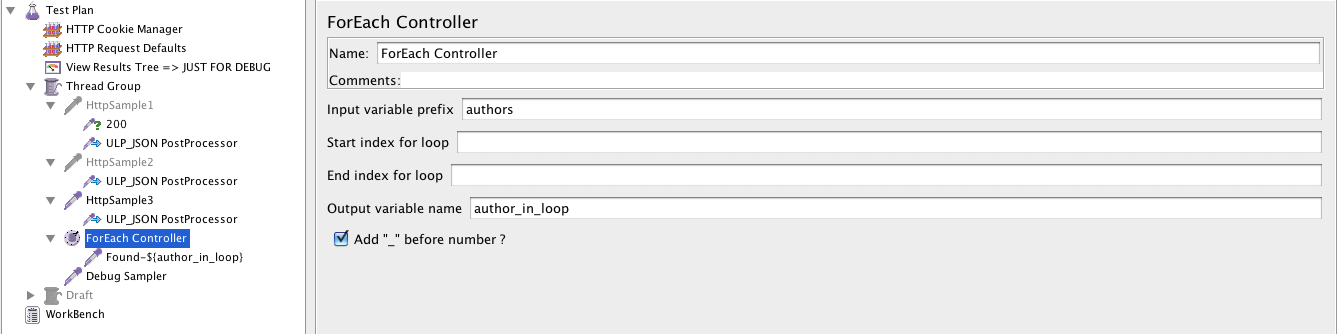
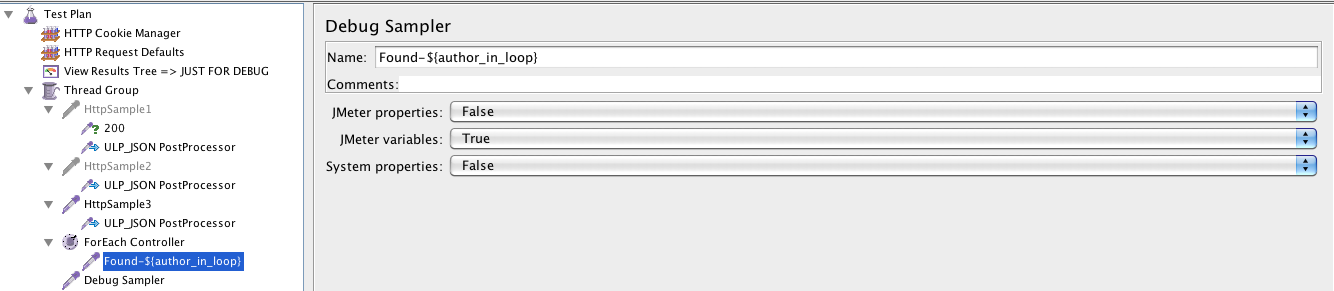
Running this plan gives us:
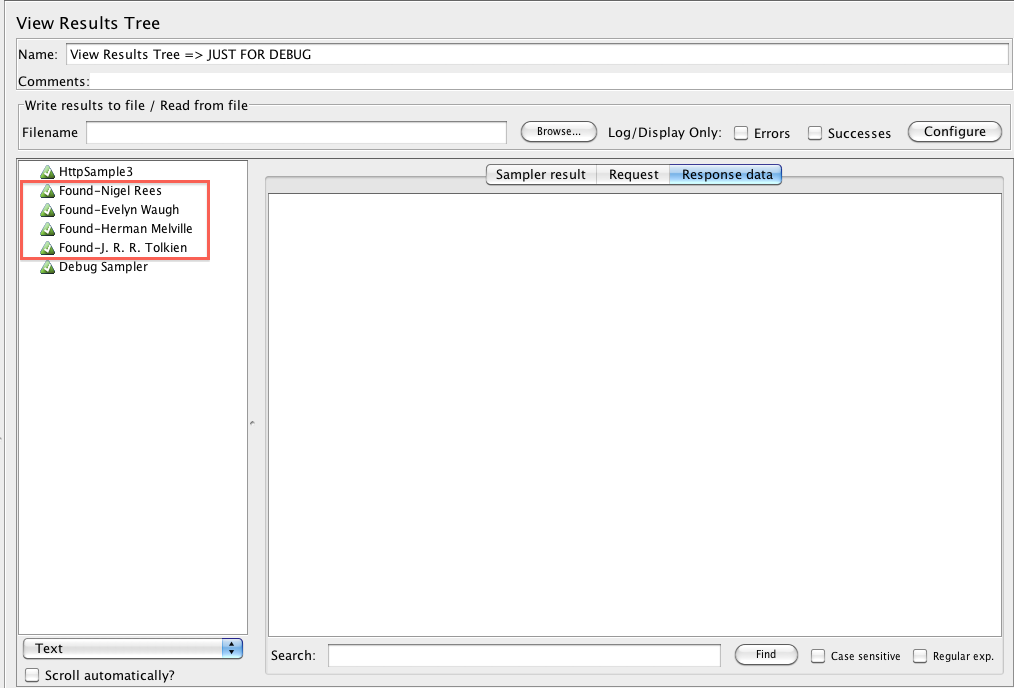
As you can see, the ULP_JSON PostProcessor has automatically created the necessary variables for each result found using the same behaviour as Core Regular Expression Extractor, so we have in JMeter Variables context:
- authors_1=Nigel Rees
- authors_2=Evelyn Waugh
- authors_3=Herman Melville
- authors_4=J. R. R. Tolkien
Thus we can use ForEach Controller to iterate on these variables.
Conclusion:
With our plugin your JSON based testing becomes:
- easier to script
- faster
- more maintainable
- more productive
All these advantages
- without Performance compromise as our implementation is one of the fastest of the market
- with a seamless integration with Core JMeter, so you can reuse all your JMeter Skills and learn only some extras related to our plugin
So what are you waiting for … 🙂
About author:
Philippe Mouawad works as an Architect and technical expert for Ubik-Ingenierie where he leads among other things the development of UbikLoadPack a set of Commercial Plugins for Apache JMeter allowing to load test different protocols like HLS, GWT, Flex.
Philippe is a committer on the Apache JMeter project and member of the PMC since October 2011.
Finally he is a co-author of a french book on JMeter called Maîriser JMeter: Du test de charge à Devops.
About us :
- We provide professional services for Load Testing
- We’re strong contributors to JMeter and its eco-system
- UbikLoadPack is a set of Enterprise Grade plugins for Apache JMeter. Our solutions are used by Big players
- Get a Free trial
UbikLoadPack solution


Publication